

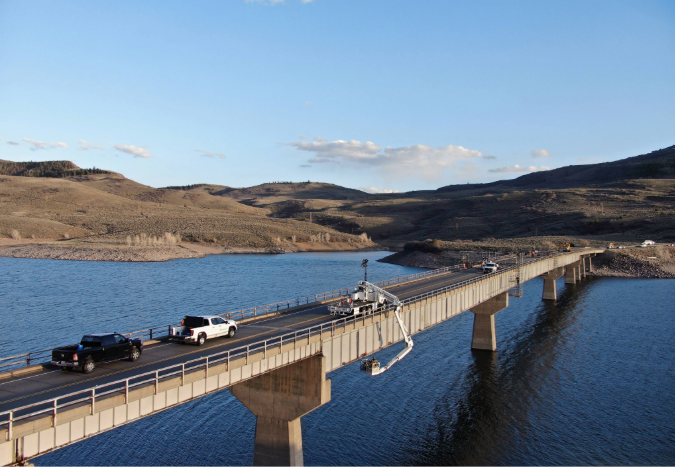
Blue Mesa Reservoir, nestled within Colorado’s high desert mesas and pinnacles, is the state’s largest body of water and a key feature of the Curecanti National Recreation Area. It’s crossed by only two long-span steel bridges—Lake Fork Bridge (K-07-A) and Blue Mesa Middle Bridge (K-07-B)—which carry US 50 traffic. Following safety concerns and a Federal Highway Administration mandate for non-destructive testing of fracture-critical members, inspectors discovered a 2.5-inch crack and weld defects on the Blue Mesa Middle Bridge in April 2024, prompting an immediate and indefinite closure by the Colorado Department of Transportation (CDOT).
CDOT quickly engaged Michael Baker, immediately authorizing the team to evaluate inspection reports, identify the type and severity of issues, model bridge capacity, and formulate a plan for interim and permanent fixes on the bridge. Additionally, Michael Baker’s civil design team provided design support to prepare gravel county roads to accommodate piloted detours. The project also included inspection and permanent repairs for the Lake Fork Bridge.
Technical challenges required close collaboration between Michael Baker, contractor Kiewit and experts at Purdue University. Together, the team developed an innovative strategy to protect against future cracks in web-to-flange welds. Nicknamed the “plinko plate,” the strategy consisted of a closely spaced pattern of offset crack arrest holes and an overlying plate to contain any future cracks before they become a safety concern.
Emergency repairs on the Blue Mesa Middle Bridge were completed by July 4. After 20,000 design hours, installation of 410 tons of steel plate and more than 50,000 bolts, permanent repairs were completed on both bridges, and they fully reopened before Thanksgiving 2024.