

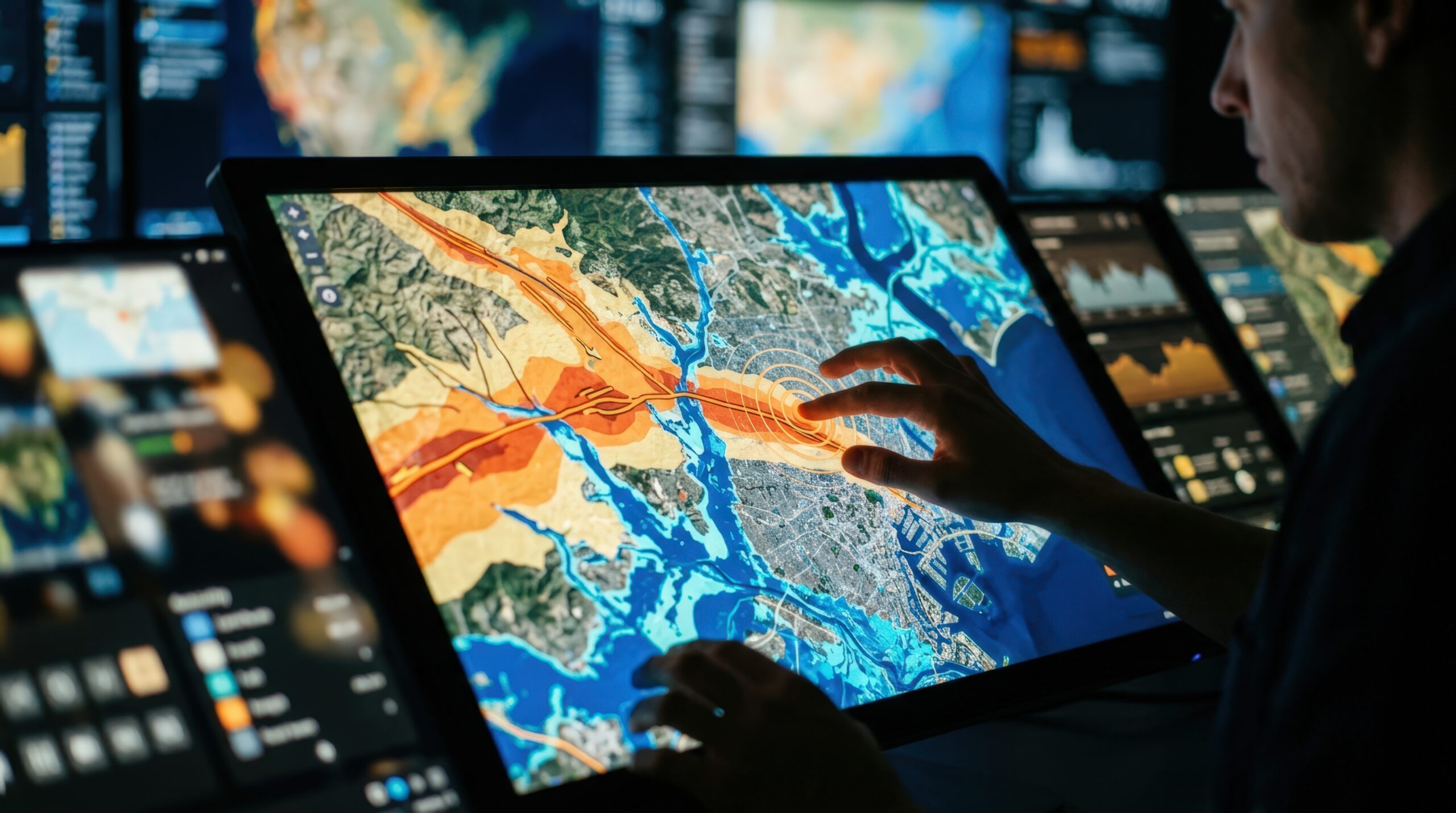
Michael Baker International Shares Insights on recent report, Harnessing AI for Flood Risk Management: Integrating People, Data, and Action.
A new summary report, Harnessing AI for Flood Risk Management: Integrating People, Data, and Action, is a follow-up to the 2025 Gilbert F. White National Flood Policy Forum, hosted by the ASFPM Foundation, held last year in Washington, DC. The forum brought together leaders from across floodplain management, policy, engineering, and technology to examine how artificial intelligence and big data are beginning to influence the future of flood risk management. The report captures the depth of that conversation and offers an important perspective for practitioners, policymakers, and organizations working to strengthen resilience. Michael Baker International was a sponsor of the Forum.
Why this forum matters
Flood risk management is becoming more data-rich, more complex, and more urgent. As communities face growing pressure to make sound planning, infrastructure, and resilience decisions, conversations around the role of AI are becoming increasingly important.
The ASFPM Foundation’s forum focused on how AI can support floodplain management while reinforcing the need for transparency, defensibility, and sound professional judgment. The discussion was not about replacing people with technology. It was about understanding where AI can improve efficiency, insight, and communication, and where human expertise must remain firmly in the lead.
Key themes from the report
The report highlights three overarching takeaways that stood out across the forum discussions:
- It starts with data: AI is only as strong as the data behind it. Data quality, governance, consistency, and accessibility all shape whether AI tools can produce useful, trustworthy outputs.
- AI should support (not replace) human expertise: One of the report’s clearest messages is that AI is a tool, not a substitute for professional judgment. In flood risk management, where decisions affect public safety, property, investment, and long-term planning, human oversight remains essential.
- Innovation needs guardrails: The report emphasizes that AI’s potential should be paired with strong governance, transparency, accountability, and fit-for-purpose use. Responsible adoption is what will allow the industry to benefit from AI while maintaining trust and rigor.
Where AI may help advance flood risk management
The report explores opportunities for AI across five facets of floodplain management:
- Hazard and risk identification
- Standards, regulations, and compliance
- Communication
- Mitigation and resilience measures
- Risk transfer
Across these areas, AI shows promise in supporting faster data analysis, improved communication, better access to information, and more efficient workflows. At the same time, the report underscores the importance of explainability, repeatability, and responsible application.
A roadmap for responsible progress
The report also outlines 11 recommendations to help agencies, practitioners, and partners thoughtfully integrate AI into floodplain management over time. These recommendations include advancing AI governance frameworks, publishing use cases, strengthening professional standards, improving data transparency, upskilling the workforce, and exploring pilot projects and regulatory sandbox concepts.
Taken together, the recommendations provide a practical starting point for organizations that want to engage with AI credibly, measuredly, and aligned with the public interest.
Michael Baker’s commitment
Michael Baker International supports forums like this that encourage collaboration across disciplines and help shape the future of resilient communities. Sponsoring the 2025 Gilbert F. White National Flood Policy Forum reflects our commitment to encouraging thoughtful dialogue on innovation, public safety, and the evolving tools that help communities better understand and manage flood risk.
As the industry continues to evaluate the role of AI in floodplain management, one thing is clear: progress will depend not only on technological advancement, but also on strong data, responsible governance, and expert human judgment.
Read the ASFPM Foundation’s report to learn more about the conversation shaping the future of AI in flood risk management.