

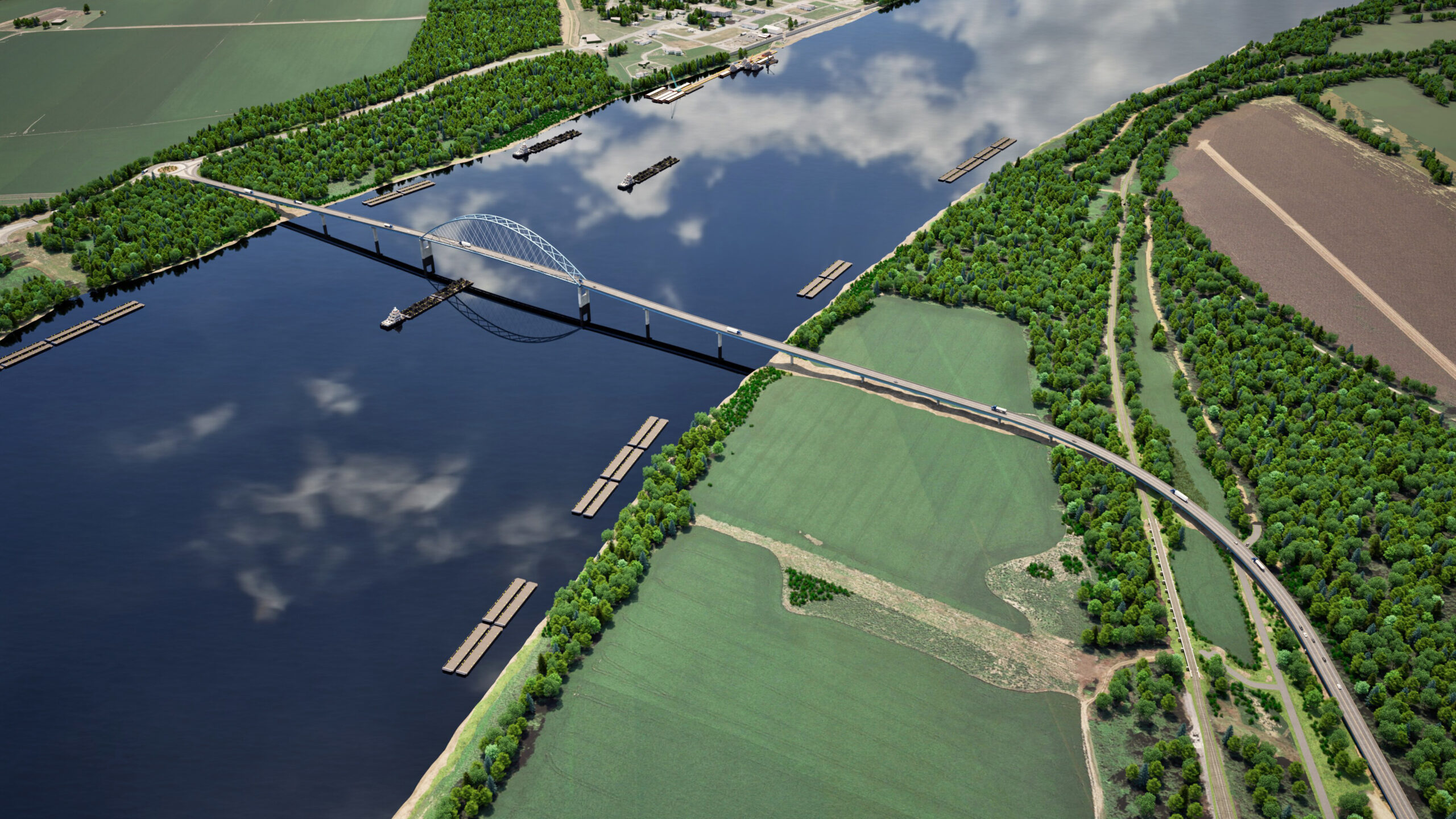
The movement of people and goods by both land and sea is critically important to our nation’s economy, as well as for the traveling public going from point A to point B. Throughout the United States, there are 25,000 miles of inland navigable waterways using 239 locks, forming a network known as the “water highway.” The U.S. also has roughly 3.5 million miles of rivers and tributaries that connect to the sea, while the land highway network has a total length of 4.17 million miles, aided by more than 617,000 bridges from coast-to-coast.
As engineers, safety is at the heart of everything we do. When we design bridges, we are working to ensure the safety of both vehicles traveling across the bridges and vessels traveling underneath the bridges. One key consideration is designing for vessel allision. That is, a ship striking a stationary object like a bridge as opposed to collision, which is a ship striking another moving object. This requires the collective talents of multiple disciplines, including structural engineers, hydraulic engineers, geotechnical engineers and stakeholder engagement.
The American Association of State Highway and Transportation Officials’ (AASHTO) Load and Resistance Factor Design (LRFD) Bridge Design Specifications 3.14 provides the framework for the design of accidental allision between a ship and a bridge. This probabilistic approach was developed to quantify the many low probability random chance variables that contribute to the overall risk of the bridge collapsing due to an accidental vessel strike.
As it turns out, two factors are the most important to determining demands placed on the structure: vessel weight and anticipated vessel speed. Let’s look at these two key items.
Vessel Weight
The vessel weight is a function of the facility being crossed by the bridge. On ocean-going ports, like the new Mobile Bay Bridge, which carries Interstate 10 across Mobile Bay from the George Wallace Tunnel on Blakeley Island in Mobile, Alabama, eastbound to Spanish Fort/Daphne, Alabama, large container ships will traverse under the bridge. These large vessels are in what the U.S. Coast Guard (USCG) calls blue water (oceans) and can range in size from small fishing boats to large Suez Max tankers weighing in at more than 150,000 tons. Each bridge site must understand the fleet characteristics.
Crossings over inland waterways, like the new US 51 Bridge, which spans the Ohio River between Wickliffe, Kentucky, and Cairo, Illinois, are in what the USCG call “brown water.” That is, most of the commercial traffic is made up of flotillas of individual barges pushed by a tow boat. These flotillas are typically made up of two types of barges: 1) bulk dry cargo barges approximately 35 ft. x 200 ft. and weighing over 2,000 tons, and 2) liquid tanker barges approximately 54 ft. x 300 ft. and weighing over 5,000 tons.
The key stakeholders, including the shipping and barge companies, can provide critical feedback on the type, size, configuration and number of vessels using a waterway. Other sources of government and privately collected data can be used to determine the fleet characteristics.
Anticipated Vessel Speed
The speed of the vessel is a function of the ship or tow boat speed and the water velocity. For coastal locations, the tidal movements can result in flows going in both directions, but typically relatively slow water velocities. However, inland waterways can have significant velocity depending on the river characteristics. Working with hydraulic engineers to determine water velocity and talking to stakeholders familiar with the typical operating speeds is imperative.
Other factors contributing to the risk include known history of vessel aberrancy (vessel deviating from their intended path in this part of the waterway), the geometric layout of the bridge (span length, skew angle, etc.) and pier capacity.
One final decision must be made by the owner of the bridge to determine the risk tolerance. Bridges are designated as either typical or critical/essential. Recently, our team at Michael Baker International has completed projects on the Gulf Intercoastal Waterway (GIWW), Tennessee, Cumberland, Ohio, Mississippi, and Arkansas Rivers. Throughout these projects, we found that the design demands are not significantly altered based off the owners choice of risk tolerance. Given that bridges over navigable waters are usually significant structures, designating the bridge as critical/essential for the purposes of vessel allision design is advisable and further adds to the safety of the structure.
June is National Safety Month, the annual observance to promote workplace safety. At Michael Baker International, safety is at the forefront of everything that we do. From the design table to the project site, success is measured by our people and safety culture. We utilize our S.L.A.M. safety tool and process to strengthen our safety culture, promote safety awareness, recognize hazards and assess and manage risk. This includes:
STOP and consider risk in surroundings and the environment
LOOK for hazards with harm potential
ASSESS the risk
MANAGE the risk
Each year, we recognize Michael Baker project teams that demonstrate a commitment to safety with the S.L.A.M. Safety Award. Each winning team has improved safety processes, contributed to our company’s safety culture and achieved outstanding safety performance over a significant period of time.
As National Safety Month ends, we are excited to announce this year’s S.L.A.M. Safety Award winners: the Interstate 78 Reconstruction CM/CI and ConocoPhillips Spring Breakup Teams.
Learn more about each of the projects below!
S.L.A.M. Construction Services Winner: Interstate 78 Reconstruction CM/CI
Interstate 78 (I-78) spans 144 miles across Pennsylvania, New Jersey and New York, linking Harrisburg to Lower Manhattan. The I-78 Reconstruction project aimed to reduce the high crash and fatality rates in an 8-mile stretch that had 71% more crashes than other Pennsylvania expressways and a fatality rate 40% higher than elsewhere in the state. Traffic studies estimated 45,000 vehicles traveled through the project daily, with tractor-trailers making up 40% of the traffic. The winding, hilly contours made it difficult for truck drivers to see traffic ahead of them, and the lack of shoulders left no room to pull over in an emergency. This reconstruction and safety improvement project was designed to widen the shoulders along the corridor and add dedicated climbing lanes for trucks.
Michael Baker and our subconsultants provided construction inspection and management services from preconstruction through project completion and forensic analysis of the long-life concrete pavement. Two full-time on-site Michael Baker construction managers and up to six construction inspectors were co-located with the Pennsylvania Department of Transportation (PennDOT) personnel in a mobile field office.
The project took almost five years to complete and encompassed 54 lane miles of long-life concrete pavement, one million cubic yards of excavation, six bridges, 10 stormwater basins, three sound walls, two dynamic message signs, 10 property demolitions, 20 well abandonments, two underground storage tank removals, over eight miles of guide rail, over 10 miles of drainage pipe and concrete barrier, two stream relocations, and two Geosynthetic Reinforced Soil slopes.
The project’s greatest risk was live interstate traffic, which often traveled at speeds exceeding the posted speed limits and contained a significant percentage of tractor trailer traffic. The project team assessed construction activities and how the inspectors and contractors could minimize the risks by ensuring adherence to proper safety practices and protocols, including: holding weekly safety briefings to reinforce relevant safety practices; providing staff with hard hats equipped with retroreflective stickers for higher visibility; and making upgrades to flashing yellow lights on vehicles to alert travelers when the inspection team was entering and exiting traffic lanes and construction work zones.
To complete the project in phases, traffic control had to be adjusted at various stages. As planned, these “traffic switches” would have required 25 working nights of unique temporary traffic patterns with orange barrels being the only means of protection between live lanes of traffic and the field staff. The team decided that a single weekend with 24/7 lane restriction would be more efficient and accomplish the task in a safer manner. The weekend lane restriction allowed the switch to be completed in 2½-days compared to the planned 25 nights, thereby significantly reducing the risk of accidents to our crews and the motoring public, as well as the exposure of daily traffic to temporary barrier blunt end.
An additional challenge was the Governor’s unexpected COVID-19 shutdown of all PennDOT projects across the state in March 2020. This project was critical enough to restart 30 days later under strict safety protocols dictated by the Centers for Disease Control, PA Health Department, Berks County and Michael Baker’s Health & Safety Department.
Of the project, a PennDOT representative noted: “Michael Baker’s team worked to find solutions to safety concerns and field issues every day of this five-year project. The numbers of hours posted by this team without incident is a great testament to the practice of Safety First.”
S.L.A.M. Field Services Winner: ConocoPhillips Spring Breakup Team
Michael Baker has conducted hydrologic studies at the Colville River Delta since 1998 for ConocoPhillips Alaska’s North Slope Alpine Development. The field program begins in mid-April and typically lasts six to eight weeks. The project sites are not easily accessible and program set-up is conducted in sub-zero conditions. The field crews traverse ice, snow and uneven tundra and are exposed to possible wildlife encounters including brown bears and polar bears.
During spring “breakup” – when snow melts from the Brooks Range and facilitates the downstream movement of meltwater and ice as it flows north into the Beaufort Sea – the Michael Baker Hydrology team executes an extensive field program to determine peak discharge, peak water levels, flow distribution and observations at several key locations in the delta.
The annual monitoring program supports ConocoPhillips’ permit stipulations, permitting and NEPA documentation, early detection of potential flooding and ice movement, and informs infrastructure design of roads, culverts, bridges, gravel pads and pipelines. Spring breakup monitoring is integral to understanding regional hydrology and ice effects, establishing appropriate design criteria for proposed facilities and maintaining the continued safety of the environment, oilfield personnel and existing facilities during the flooding event.
The team identified numerous hazards and risks on the project, including weather exposure frostbite and hypothermia; slips, trips and falls; and wildlife interactions, among others. They also helped ensure the safety of one another and the successful completion of the project without any reportable injuries or incidents by implementing safety measures like holding daily safety meetings and operator briefings; wearing arctic survival gear during travel and carrying a survival kit and extra gear/supplies; and using Alpine facility radios when available, cell phones, emergency personal locator beacons (EPLBs) and satellite communications devices.
The ConocoPhillips Spring Breakup hydrology program has evolved since 1998, expanding from a handful of monitoring locations to what now amounts to over 60 monitoring sites. Throughout the past 26 years, Michael Baker has continued to adapt its safety processes and has collaborated with ConocoPhillips’ Safety team to develop extensive and thorough Health, Safety & Environment (HSE) plans on an annual basis.
According to a ConocoPhillips representative, the Michael Baker field personnel are “trail breakers” in the field program, and our safety documents have been hailed as a standard for other field programs.
At Michael Baker International, a focus on safety is our highest priority. We consider safety to be the lynchpin of our daily operations, and every employee – whether working in the field, remotely or in an office location – has the responsibility of maintaining a safe work environment.
We utilize our S.L.A.M. safety tool and process to strengthen our safety culture, promote safety awareness, recognize hazards and assess and manage risk. This includes:
- STOP and consider risk in surroundings and the environment
- LOOK for hazards with harm potential
- ASSESS the risk
- MANAGE the risk
The S.L.A.M. Safety Award is an annual award recognizing Michael Baker teams that improved a safety process, contributed to this safety culture and achieved outstanding safety performance over a significant period of time.
As National Safety Month comes to a close, we are excited to announce this year’s S.L.A.M. Safety Award winners: SEPTA’s Elwyn to Wawa Restoration Project (S.L.A.M. Construction Services) and the Santa Ana Construction Stormwater team (S.L.A.M. Field Services).
Learn more about these projects below!
S.L.A.M. Construction Services Winner
SEPTA Elwyn to Wawa Restoration Project
Middleton Township, Pennsylvania
Michael Baker provided Construction Management services for the $198 million Elwyn to Wawa Restoration Project. Michael Baker worked with the Southeastern Pennsylvania Transportation Authority (SEPTA), the contractor and the designer of record to restore more than 3.5 miles of Regional Rail service, including four bridges, five culverts, a new pedestrian culvert, an overhead catenary system, stormwater management measures and geotechnical slope stabilization features.
As construction manager for the project from March 2018 to August 2022, Michael Baker provided a construction field team responsible for proactively driving performance. Personnel included a construction manager, senior inspectors, project engineer, document controller, material testing, as well as working closely with a separate consultant providing special inspections and the SEPTA’s on-site project team.
The construction project encountered a range of risks, including standard hazards like falls and equipment accidents, as well as unique challenges such as COVID-19 protocols, a variety of frequently used equipment and working around active rail tracks. To mitigate the identified risks, close collaboration took place between the project team, contractors and SEPTA. Safety measures included site-specific work plans; regular inspection of equipment including cranes; schedule and scope adjustments to minimize impact to active railroad tracks; safety compliance monitoring; and special personal protective equipment and training.
Through the implementation of comprehensive safety measures, proactive risk management, and a strong safety culture, the project team successfully completed the construction project in time for SEPTA’s return of passenger rail service in August 2022 and without any safety incidents related to working around active tracks.
S.L.A.M. Field Services Winner
Santa Ana Construction Stormwater
Santa Ana, California
In 2020, the Apple Fire caused severe damage to the San Gorgonio Flowline No. 1 Hydroelectric Facility, located in Riverside and San Bernardino Counties, California. This facility provides the primary water source to the Banning Bench Community, a small unincorporated area disconnected from the City of Banning. Southern California Edison (SCE) led repairs to restore the water supply, including pipe replacement and slope stability improvements.
Michael Baker served as the stormwater and erosion and sediment control expert for the project. Staff were responsible for identifying potential sources of pollution and designing temporary Best Management Practices (BMPs), both structural and non-structural measures to prevent stormwater pollution from the site. Once the Stormwater Pollution Prevention Plan (SWPPP) was in place, Michael Baker assisted SCE in the permitting process for coverage under the California Construction General Permit. After construction began, Michael Baker’s role shifted to field inspections, ensuring that the designed BMPs were in place and modified based on changing field conditions. Staff also provided contractor training, stormwater monitoring and sample collection, field reporting, and multi-agency regulatory coordination.
The San Gorgonio Mountains are associated with numerous safety hazards, including extreme weather – especially flash flooding – steep, rocky terrain, and potential encounters with wildlife, including bears, mountain lions, rattlesnakes and insects. Additionally, the project work areas included narrow, winding access roads in extremely remote areas with steep drops on one or both sides, as well as risks associated with heavy equipment, hazardous materials, helicopter activity and limited cell phone service. The team implemented safety measures including developing a detailed Health and Safety Plan (HASP); ensuring appropriate personal protective equipment; utilizing satellite texting communicators for projects areas without cell phone reception; providing a designated four-wheel drive fleet vehicle; providing training and education; implementing a system of continuous improvement; and conducting regular safety inspections, among others. This resulted in a safe and highly successful project.
In the summer of 2022, heavy rains, coupled with a drought that prevented soil from soaking up water, led to devastating flooding throughout Eastern Kentucky. By July 28, upwards of eight inches of heavy rain had fallen overnight and Kentucky Governor Andy Beshear declared a state of emergency. The rainfall continued through the next few days for a total of more than 10 inches. The impact was immense and widespread: many roads and driveways were blocked by debris or washed away and hundreds of bridges were damaged. In many instances, these roads and bridges provided the only access points for those living in this rural area and reestablishing these connections as quickly as could be safely done was of the utmost importance.
The road to recovery began immediately. Several members of Michael Baker International’s Bridge Practice quickly volunteered to work over the weekend assisting client Kentucky Transportation Cabinet (KYTC) in the aftermath of the massive floods. Collectively, KYTC, our Michael Baker team and other partners inspected nearly 1,100 bridges in seven counties hardest hit by the flooding. Over just two days, Michael Baker worked tirelessly to ensure the safety of more than 100 bridges in Perry County. Of those bridges, we recommended the complete closure of two bridges and identified eight bridges with structural issues that will need to be assessed in the future.
Following the initial inspections, our team was engaged to provide the design for 11 full bridge replacements under a separate contract. Notably, this group of bridges was the first let by KYTC in conjunction with the disaster response. Our team provided a full spectrum of services, ranging from road and bridge design to environmental, right-of-way (ROW) and utility design and coordination.
We approached each bridge design individually, selecting the best alternatives for each rather than trying for a one-size-fits-all approach. This resulted in various types of bridge, including aluminum box culverts, reinforced concrete box culverts and adjacent box beams. All of these structures are expected to be opened in 2023.
Throughout this project, we identified several best practices for disaster response and emergency recovery:
Assemble the Best Team
At Michael Baker, we’re able to draw from a deep bench of more than 3,500 colleagues across 100 offices. With our Wolf Pack Philosophy top-of-mind, more than 30 offices offered their assistance in the first hours following the flooding event and throughout the design process, our Louisville team was joined by colleagues from Pittsburgh, Pennsylvania; Chicago, Illinois; Harrisburg, Pennsylvania; Cincinnati, Ohio; Virginia Beach, Virginia; Greenville, South Carolina, and more. Because of the diversity in expertise at Michael Baker, we’re able to bring in the right people for the job, allowing us to work quickly and to the highest level of accuracy.
Communication is Key
This project needed to come together quickly, while keeping multiple stakeholders informed and involved every step of the way. We worked with various groups throughout the inspection process, and each of the 11 bridges being designed had a different set of stakeholders. We adopted a “more is more” mindset, overcommunicating to ensure all parties had the information they needed.
We also were on the ground with various agencies also tasked with disaster relief, including the U.S. Army Corps of Engineers (USACE) and Federal Emergency Management Agency (FEMA), the latter of which contributed funding for the emergency work.
Focus on the Right Alternative
As we moved into design, we focused on identifying the right alternative for each of the 11 bridges under Michael Baker’s scope. We needed to strike the balance between being fiscally responsible with getting the bridges designed and constructed as quickly as could safely be done. Each bridge was designed to meet not only modern standards, but also the specific needs of the location. Additionally, we focused on options that would expedite the process. For example, we had to design the bridges without buying additional ROW or relocating utilities.
Be Flexible
Under traditional circumstances, the design process would have commenced linearly, with hydraulics and surveying work occurring before design. However, we did not have the luxury of time and had to move these elements forward in parallel. This required us to make engineering judgment decisions and at times, we needed to rework designs based on what we encountered once we were in the field and into construction. Although this required more effort, being flexible allowed us to move the project into construction fast, ultimately restoring access for residents as quickly as possible.
Be Prepared
Throughout this project, we encountered challenges that had nothing to do with inspection or design. One such instance of this was the unreliable cell phone service in rural Kentucky, which added a layer of complexity when navigating the area and inventorying bridges. We also needed to be ready for conditions that you’d expect from a disaster recovery situation and we brought in supplies should they be needed.
Today is World Water Day, promoting the responsible use of water and access to clean water for all. At Michael Baker International, our Water Practice professionals provide innovative consulting, planning and engineering solutions for the entire spectrum of the water cycle.
Learn more about some of the exciting projects that our Water Practice team recently completed below!
Knox Lake Dam Improvements Project
Knox County, Ohio
Michael Baker provided engineering services for the Knox Lake Wildlife Area Dam Improvements project in Knox County, Ohio, which is owned and operated by Ohio Department of Natural Resources (ODNR) Division of Wildlife. Improvements were needed to bring Knox Lake Dam into compliance with current regulations, and Michael Baker was selected as the Prime/Engineer of Record for the project. From 2018 to 2021, our team completed several key updates to the dam, including constructing the dam while maintaining a pool in the reservoir; salvaging the existing spillway; rehabilitating the control tower; improving the embankment and creating better access. The improvements to the Knox Lake Dam not only brought the dam into compliance with the latest regulations, but also improved the overall resiliency of the structure.
Eastern Service Area Secondary Connection Project
San Diego County, California
Michael Baker International was contracted by the Padre Dam Municipal Water District (Padre Dam) as the Prime Design Consultant for the Eastern Service Area Secondary Connection Project (ESASCP) in San Diego County, California. This project was the largest and one of the most complex projects in the District’s history. Prior to this project, the eastern portion of the District’s service area was supplied water through a sole backbone pipeline with minimal looping. Padre Dam’s ability to serve many customers could be critically affected if the backbone pipeline were to be compromised.
To address this issue, Michael Baker performed preliminary and final engineering design, which included 7,500 feet of welded steel pipeline; an Interstate 8 tunnel crossing; a 1.75 Million Gallon (MG) circular pre-stressed concrete forebay reservoir; a pump station; flow control facility to be owned by the SDCWA and operated by Helix Water District (HWD); a standby generator; flow and pressure control valve stations; and supervisory control and data acquisition systems. Work also included a surge analysis, corrosion control, geotechnical engineering investigation, permitting with the County of San Diego and Caltrans, and approvals from the California Fish and Wildlife Service and California Regional Water Quality Control Board.
This week marks National Surveyors Week, an annual celebration of surveyors and the land surveying profession. Michael Baker International was founded in 1940 as a surveying and engineering design company and today, surveying remains woven into the fabric of our company’s history. Today, we are sharing some of the recent projects from our team of expert surveyors.
Southern California Edison Surveys
In 2022, Michael Baker International was approached by Southern California Edison (SCE) to perform right-of-way and topographic surveys across California. Because the projects required field survey and were located across the state, a key component to success was an efficient and strategic field survey campaign. In the field, the latest global navigation satellite system (GNSS) equipment, a constellation of satellites providing signals from space that transmit positioning and timing data to GNSS receivers, and mobile and static Light Detection and Ranging (LiDAR), a remote sensing method that uses light in the form of a pulsed laser to measure variable distances to the Earth, were used, enabling the collection of more than 20 miles of roadway topography. Geographic Information Systems (GIS), computer-based tools used to store, visualize, analyze, and interpret geographic data, were put in place to collect geolocated images of all SCE power poles and survey control. This enabled additional efficiencies within the office processing workflow. As data compilation was nearing completion, the team completed quality control reviews and submitted final deliverables.
ADA Compliance Topographic Surveys
Members of our Surveying Practice recently conducted Americans with Disabilities Act (ADA) compliance topographic surveys for four sites in Las Vegas, Nevada, and one site in Bryce, Utah. The surveyed sites included a variety of unique features and were also comprised of multiple buildings with separate entrances to multi-story buildings with underground parking, as well as ADA-compliant pathways that lead to outside recreational and pool areas. To complete these surveys in the time allotted, the team surveyed the sites using Static Scanning with GNSS Control. Static Scanning is a way of collecting survey data (point cloud data) that gives the team a complete picture in time of the entire site at the time of the survey. This modern technology allowed our experts to complete projects while saving both time and cost.
UAS and Dam Surveys
Michael Baker’s Surveying team, in partnership with our Consulting & Technology Solutions (CTS) vertical, recently surveyed five dams in Schuylkill County, Pennsylvania using Unmanned Aircraft Systems (UAS) and LiDAR data collection. The UAS team spent a week collecting aerial data of the five dams using an unmanned aerial vehicle (UAV) – or drone – as the surveying team mobilized at the sites to locate the ground control using GNSS Survey equipment. This LiDAR point cloud collected by the UAV was a more efficient way to collect the topographic data. The team also conducted bathymetric surveys, or water surveys, on four lakes to help determine silt volumes and capacity.
The seven-mile stretch of Pennsylvania State Route 222 (SR222) between the Kutztown Bypass and the Reading Bypass in Berks County, Pennsylvania, is a picturesque corridor that draws heavy truck traffic to and from New York, volume that historically created significant back-ups at the highway’s three major intersections.
Congestion was especially hazardous for local residents, who depend on SR222 to get practically everywhere. Many of those residents belong to the Mennonite community who cross SR222 with horse-drawn buggies.
In 2011, the Pennsylvania Department of Transportation (PennDOT) engaged our team at Michael Baker International to manage a highway improvement project that encompassed three miles of the corridor, the SR222 North Corridor, Phase 1 Project, and engaged us to design those improvements. Our team created a solution simultaneously simple and effective: replace existing traffic signals and stop signs at two of the intersections with roundabouts.
Our team designed hybrid roundabouts featuring two lanes, narrowing to single lanes where appropriate, to allow simultaneous use by pairs of trucks. This was one of the first times hybrid roundabouts were used in Pennsylvania.
We encountered several complexities as the project was designed and constructed. There were many utilities along the corridor that needed to be coordinated and in addition, our team created a maintenance of traffic plan that targeted much of construction during nighttime hours.
Throughout the design and construction of this project, our team encountered challenges, leading to lessons learned.
A commitment to adapt and persevere.
This project was more than a decade in the making. During that time, we experienced many changes. This spanned from changes in timelines to changes in project limits and preferred design alternatives. Through it all, our team adapted and persevered to ensure the successful completion of the project.
A focus on goals.
The purpose of this project was to enhance the intersections to allow for increased capacity while improving safety along the SR 222 corridor. The project has improved intersection operations, overall delay through the corridor and pedestrian accessibility. While there was no question about the purpose of the project, the public and local stakeholders initially were unsure about the use of roundabouts. Our design team and client were unwavering in the belief that modern roundabouts would improve traffic flow and provide immense safety benefits over the existing intersection configurations. Public outreach and education were essential to educate the community that our alternatives would provide them with a less congested, efficient and safer roadway.
A focus on communication.
We brought together the design and construction teams with the goal of working as one entity. To achieve this, we established constant communication between all team members and our additional stakeholders. We knew that construction would impact this highly traveled regional arterial, so bi-weekly status meetings became the norm during peak construction activities. The combined design and construction team, along with PennDOT, used this time to keep business owners, local police and township officials abreast of upcoming construction activities, roadway closures and nighttime work. This coordination and communication allowed potential issues to be identified early and addressed in a timely manner.
An unprecedented complexity.
The project began construction in the fall of 2019 and was impacted in March of 2020 by the COVID-19 pandemic. When the team was cleared to resume construction, the new pandemic protocols added an additional layer of coordination. The use of technology and collaboration tools – like video conferencing and instant messaging – were bridged the gap when we were unable to physically be in the same place. This was a huge undertaking during construction, where most problems are typically solved in the field with face-to-face interactions.
The result.
The roundabouts opened in June 2022 and quickly achieved their principal objective, reducing travel time by about 25 percent.
Encinitas, California, is a vibrant coastal city in San Diego County. Recently named among the 20 best surf towns in the world by National Geographic, Encinitas is an eclectic mix of 1960s-inspired beach culture combined with thriving local restaurants, shops, art galleries and more.
In 2008, the Leucadia Streetscape Project originated as a vision to preserve and revitalize the North Coast Highway 101 Corridor, Encinitas’ main business district. This kicked off a decade of planning, design, construction and overcoming challenges to see the project from initiation to completion. Serving as the lead designer on the Leucadia 101 Streetscape Project, Phase 1, our team at Michael Baker International partnered with the City of Encinitas to make improvements to this important thoroughfare to increase walkability, promote varying modes of transportation, create safer traffic flow and enhance scenic areas as well as the environment.
We achieved this through new intersections with ADA crossing and pedestrian ramps, 11 new crosswalks, wider sidewalks, a road diet, new bike lanes and parking spots, 0.4 miles of streetscape, a new roundabout, new streetlights and the restoration of the historic tree canopy with the planting of 100 new trees, as well as the implementation of low-impact design measures and sustainable green streets concepts including infiltration, biofiltration and water storage areas.
Through the process, we learned several valuable lessons:
- Perseverance pays off. This project was more than a decade in the making. Through that time, we experienced many changes. This spanned from changes in staff to changes in timelines to changes in technology. Through it all, our team adapted and persevered to ensure the successful completion of the project.
- Stay true to the goals of the project. Throughout the entirety of the project, the public that initiated the desire for slower traffic and a bike and pedestrian-friendly corridor remained a dedicated supporter. Even when the project encountered opposition and speedbumps, we focused on the public’s and the client’s end goal as our North Star.
- Partnership begets success. The City of Encinitas was a true partner every step of the way. The City trusted our team to be an extension of theirs. We engaged with the public and explained complicated design and traffic analysis to the City Council, as well as took over the Environmental Impact Report (EIR) when the City did not have the capacity to complete it. Because our team was working in lockstep with our client through the entire process, we seamlessly took on additional tasks like last minute requests for exhibits and cost estimate iterations needed to back up decisions to elected officials. The trust that was built between client and engineer ultimately contributed to the end result.
The Leucadia 101 Streetscape Project, Phase 1, was completed in Summer 2022 and makes it easier and safer for community members and visitors alike to get to the beach and enjoy the shops and restaurants on North Coast Highway 101. Our team recently completed design of Phase 2 and it is currently out to bid.
As we celebrate Michael Baker’s founding month throughout May, we are shining the spotlight on one of our firm’s most iconic projects: the Trans-Alaska Pipeline System (TAPS). Michael Baker was a major engineering consultant for the design of the 789-mile-long, 48-inch diameter pipeline, which traverses three mountain ranges, three major earthquake faults and hundreds of rivers and streams. The four-year, $7.7 billion construction of TAPS was one of the first large-scale, privately funded projects in the world and was built through the Alyeska Pipeline Service Company, a group made up of seven oil companies.
We continue to do groundbreaking work in Alaska related to cold regions engineering and major projects along the state’s North Slope with the same spirit of innovation and commitment that inspired our work on TAPS.
Did you know?
- Since pipeline startup in 1977, TAPS has successfully transported more than 17.6 billion barrels of oil from Alaska’s Arctic Coastal Plain to the Port of Valdez, the northernmost ice-free port in the U.S.
- TAPS currently averages 450,000 barrels of oil per day.
- Approximately 50% of the pipeline is above ground.
- The pipeline was engineered in a zigzag pattern, so that it becomes flexible if needed, like during an earthquake.
Between 1969 and first oil in 1977, Michael Baker experts dedicated more than 2.5 million man-hours in civil, structural and mile-by-mile pipeline design north of the Yukon River. We were also responsible for civil design and survey of more than 200 access roads, airstrips and pipeline bridges, as well as design and survey for the U.S.’s northernmost Dalton Highway, a 358-mile haul road that links TAPS and Alaska’s North Slope oil fields to Alaska’s road system.
Keith Meyer, Chief Engineer – Oil & Gas Pipelines, was a part of this original team that designed TAPS. We sat down with him to learn more about his work on this notable project.
What stands out most to you about designing the TAPS?
The tremendous challenge of the state and its climate stand out to me. Alaska is largely unique in the U.S. experience and is very remote. Our team worked to meet unique engineering challenges in an incredibly short time and designed a system that still serves its purpose after half a century.
What was the biggest challenge you faced throughout the project and how did the team overcome that challenge?
Within Michael Baker, there were many new, never-before-applied, innovative engineering designs and analytics that we used in this project. This included pipeline aboveground supports with passive built-in refrigeration, seismic design to meet some of the highest design seismic motions on record, waterway designs with almost no historical records and material designs to withstand extreme cold temperatures.
As a junior engineer, a big challenge for me was the finite element structural analysis that we performed for the project. We used a dial-up phone connection to a remote server running with the computer program. This was the first time this was done in our department, and certainly one of the first times throughout the company. We had to learn how this would work from scratch, thankfully with much support from our co-workers. Now it is universally used – but this wasn’t the case nearly 50 years ago.
What are some of the most innovative features of the project?
Some of the innovative features included widespread use of geothermal information to ensure the hot crude oil pipeline would not adversely affect the in-situ local environment; detailed seismic analysis – in its relative infancy at that time – in consultation with leading University advisers; considering the behavior of structural elements beyond the usual stress range that codes considered at that time and using survey results in computer analyses.
How does this project exemplify We Make a Difference?
Our team at Michael Baker really came through on the project. We scoured the country for trained personnel for the many field activities, designed the road to transport materials north of Fairbanks (“the haul road”) in record time, supported Pipeline Service Company in cross-country pipeline design, designed and built several bridges and continued in post-construction support. It is no surprise that TAPS quickly became one of Michael Baker’s signature projects.
How did working on this project impact your career?
Working on my doctorate at Carnegie Mellon University, several of the seismic concepts that we used in this project gave me a better understanding of my thesis, which was based on seismic analysis. Once I obtained my doctorate, Michael Baker relocated me to California to work on a new proposed Alaska gas pipeline project in which the experience of my first Michael Baker years helped greatly. I think those early years of pushing new limits with co-workers pulling together to successfully complete the project made me think of Michael Baker as “home.”
The TAPS project was recently featured on American Built, a program on FOX Business highlighting engineering marvels across the country. View a clip here: https://www.foxbusiness.com/shows/american-built
Check your local listings or sign in with your TV provider to view the full episode on FOX Nation: https://nation.foxnews.com/american-built/
At Michael Baker International, health and safety are fully engrained in all that we do because our employees are our most valuable asset. We consider safety to be the lynchpin of our daily operations, and every employee – whether working in the field, remotely or in an office location – commits to the responsibility of maintaining a safe work environment.
We utilize a safety tool and process called S.L.A.M. to strengthen our safety culture, promote safety awareness, recognize hazards and assess and manage risk. Here’s what S.L.A.M. means:
- STOP and consider risk in surroundings and the environment
- LOOK for hazards with harm potential
- ASSESS the risk
- MANAGE the risk
As June and National Safety Month come to an end, we are spotlighting the winners of our annual S.L.A.M. Safety Award, which recognizes a project team, service group or office that improved a safety process, contributed to our safety culture and achieved outstanding safety performance over a significant period of time.
Learn more about our two winners, the Philadelphia International Airport – Terminal D/E Apron Repair project and the Hernando de Soto Bridge Inspection.
Construction Services S.L.A.M. Safety Award Winner
Philadelphia International Airport – Terminal D/E Apron Repair
Michael Baker provided engineering services for the Terminal D/E Apron Repair Project at the Philadelphia International Airport, the primary airport for Philadelphia, Pennsylvania, which serves more than 31.7 million passengers per year. Much of the existing apron and taxilane pavement located between Terminal D and Terminal E was more than 60 years old and exhibited signs of structural and environmental distress. This project provided an opportunity to replace the most troublesome and frequently used sections of concrete pavement within the Terminal D/E Alleyway.
The project replaced specific sections of apron pavement that could further deteriorate and improve the overall pavement condition. The repairs included replacement of 113, 25’ X 25’ concrete pavement panels located within the heart of the Terminal D/E Alleyway during nighttime, off-peak construction hours and within tight 4-hour time constraints dictated by airline schedules.
The safety measures implemented by the team included regrouping the full-depth pavement panel replacements to fall in a more confined footprint; identifying where construction could be isolated from taxiing aircraft; simplifying temporary taxilane movements; and enhancing communications throughout the project.
Field Services S.L.A.M. Safety Award Winner
Hernando de Soto Bridge Inspection
On May 11, 2021, inspectors from Michael Baker International were conducting a routine inspection of the upper portions of the Hernando de Soto Bridge. During the inspection a member of the inspection team fortuitously saw a major fracture in the tie girder in an area of the bridge below deck and outside of Michael Baker’s scope of work. The team moved into swift action to ensure the safety of the traveling public and the 18 rope access inspectors climbing the upper portions of the bridge. After confirming the critical finding, the team moved quickly. The team immediately contacted the Arkansas Department of Transportation (ARDOT), the lead agency for the bridge’s biannual safety inspection, the Tennessee Department of Transportation (TDOT), the lead for maintenance and construction activities associated with the bridge, and 9-1-1 to alert them of the situation and request support to close the bridge to both automobile traffic moving across the bridge and river traffic on the Mississippi River below.
The next few minutes were critical. Michael Baker’s rope access inspectors were called down and as the team awaited support from local authorities to close the bridge, they moved off the structure down each of the westbound and eastbound lanes dressed in neon colors, waving their hands and stopping traffic. With the assistance of the Memphis police, the bridge was quickly evacuated. In addition to stopping vehicular traffic on I-40, all river traffic was immediately halted on the Mississippi.
Following the initial discovery of the fracture, the Michael Baker team used unmanned aerial systems (UAS) to rapidly scan the rest of the structure. No additional damage was observed by the team and under TDOT, a three-phase plan was devised, with Michael Baker serving as the lead designer. Learn more about the project here.
The team incorporated safety measures including working with ARDOT on lane closures that avoided primary direction, peak rush-hour times; eliminating lifts for the 2021 inspection; minimizing at-risk hours for the rope-access inspectors; utilizing unmanned aerial systems (UAS) to scan the majority of cable lengths to eliminate numerous lengthy rappels by the climbing team; and incorporating tie-offs to minimize fall risks and enhanced lanyards to reduce the risk of dropping tools.
Congratulations to the teams on being selected as S.L.A.M. Safety Award winners and thank you for your dedication to our safety culture.