

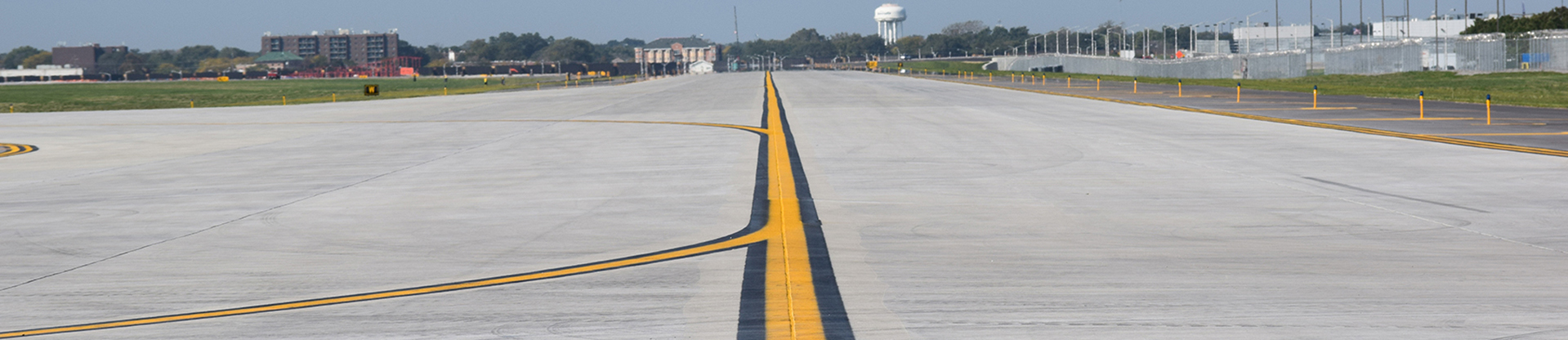
As part of the O’Hare Runway Designers, LLC (ORDLLC) team, Michael Baker served as the Lead Civil Engineer, responsible for technical coordination of all aspects of South Airfield improvements at the O’Hare International Airport. This improvement program includes the design of Runway 10R-28L with parallel Taxiway Whiskey on the south portion of the airfield.
This 7,500-foot-long, 150-foot-wide runway is the second new runway to be designed by ORDLLC as part of the O’Hare Modernization Program. Runway 10L-28R was designed mainly to provide full Category II/III arrival approaches, with the expectation of limited departure operations. The runway features state-of-the-art Navigational Aids (NAVAIDS) to support Category II/III instrument landing operations, LED lighting, and sustainable paving applications such as Warm-Mix Asphalt (WMA) and the inclusion of Recycled Asphalt Shingles. The project also included a full-length parallel taxiway system with four high-speed taxiway exits.
Our team provided technical input and consultation on every aspect of the project, including airspace issues, traffic impacts during and after construction, permits, stormwater management, erosion and sedimentation control, railroad right-of-way and construction logistics, including construction safety phasing planning and airport security matters. The project included the design of two mass grading bid packages that detailed the coordination of nine enabling projects to facilitate South Airfield improvements. We were heavily involved in developing packaging options and construction schedules to evaluate alternatives for meeting the city’s deadline for runway commissioning.
Site preparation and construction of the runway included measures to reduce environmental impacts and save costs. More than 20 percent of the materials used in site preparation for construction of the new runway were manufactured regionally, and approximately 50 percent were regionally extracted, to avoid transporting materials over long distances. During construction, more than 50 percent of the paving materials were transported from sources within a 500-mile radius and about 10 percent contained recycled materials.