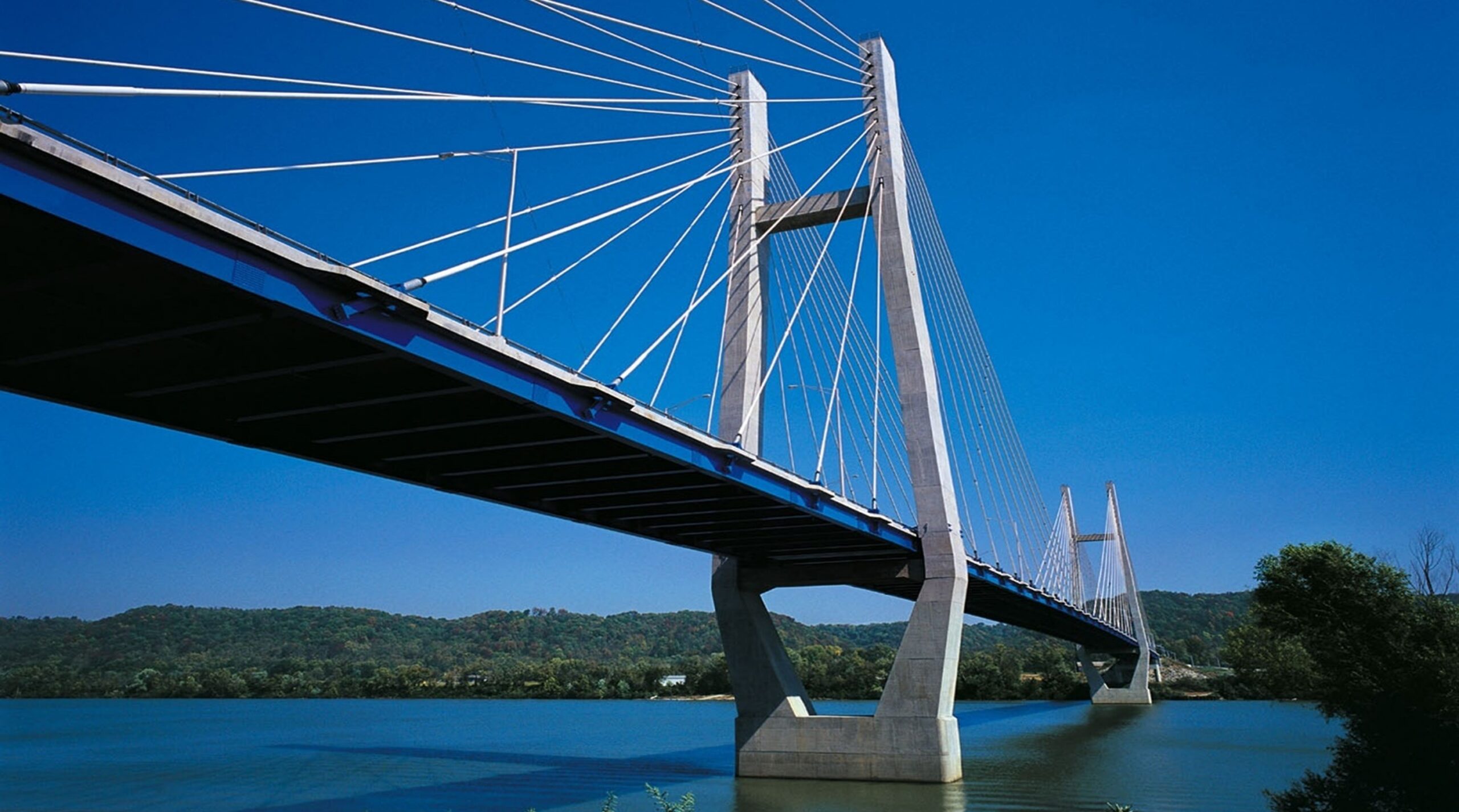
Michael Baker International, as a subconsultant to American Consulting Engineers, provided cable-stayed bridge design and engineering services for the William H. Harsha Bridge. Michael Baker provided location studies and design, preliminary design, environmental assessment, final design and construction phase services, which included staged construction analysis and support and analysis during construction.
The William H. Harsha Bridge is a 2,100-foot-long, twin tower steel-concrete composite floor system cable-stayed bridge that carries U.S. Route 62 and U.S. Route 68 over the Ohio River, connecting Maysville, Kentucky, and Aberdeen, Ohio. Named for William Harsha, who represented Ohio in the U.S. House of Representatives, the bridge was the state’s first cable-stayed design.
The William H. Harsha Bridge replaced a 1940-era suspension bridge that had deteriorated to the point that heavy trucks were prohibited, and lighter trucks had a very low speed limit. Michael Baker’s cable-stayed system solution resulted in a 13% less expensive option.
The superstructure’s cable‑stayed design incorporates a longitudinal post‑tensioned precast concrete deck slab and a post‑tensioned stay‑cable connection at the steel edge girder, creating a state‑of‑the‑art, fatigue‑resistant detail. By the time this bridge was constructed, the Michael Baker team had a strong understanding of rain‑induced cable vibration, a challenge that had affected several earlier cable‑stayed bridges and required costly retrofits with damping systems.
On the William H. Harsha Bridge, the stay cables were encased in a plastic sheath with a continuous spiral ridge that disrupts airflow and mitigates rain‑induced vibrations, providing a highly cost‑effective, forward‑looking preservation measure compared to the expensive damping retrofits required on earlier cable‑stayed bridges. The design also incorporated hold‑down devices, links, pins, and brackets connecting the edge girders to the bridge seats at Piers 3, 4, and 7 and End Bent 2 to prevent deck uplift and protect critical components over the life of the structure.
Force Regulating Units (FRUs) were installed at the towers, acting as large shock absorbers that distribute wind and seismic forces between towers and temporarily lock during extreme events to reduce long‑term structural demand. The bridge was further designed to accommodate loss of a cable and future deck replacement, supporting long‑term serviceability and preservation throughout its lifecycle.
At-A-Glance
- Served as the lead designer and provided engineering services for Ohio’s first cable-stayed design bridge
- Advanced finite‑element modeling (BRUCO, ANSYS, SFRAME) supported component analysis and step‑by‑step construction sequencing
- Cable-stayed system solution delivered a 13% reduction over alternative designs