


As transportation agencies continue advancing digital project delivery, pilot projects are playing a critical role in turning strategy into implementation. Supported by targeted federal funding, these initiatives allow agencies to test emerging technologies, validate industry standards, and demonstrate the real-world value of model-based workflows before adopting them at scale.
A Focus on Funding
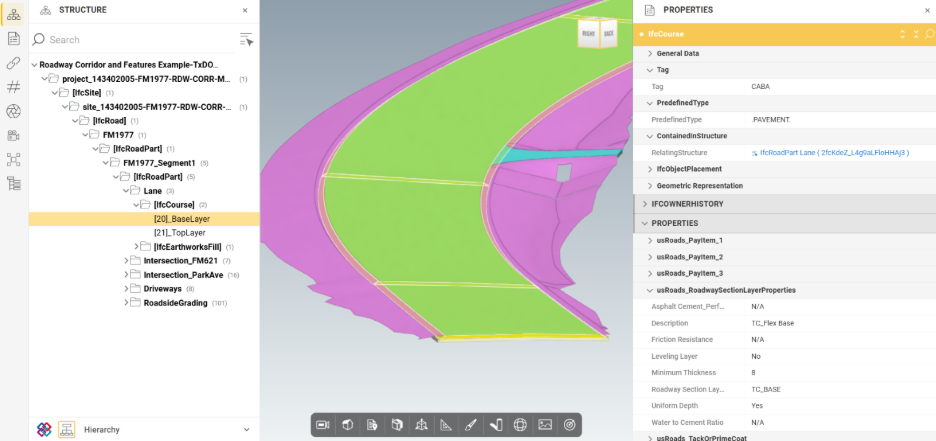
One of the most impactful ways digital project delivery is being advanced today is through the Federal Highway Administration’s (FHWA) Advanced Digital Construction Management Systems (ADCMS) grant program and Transportation Pooled Funds. Established under the Infrastructure Investment and Jobs Act, ADCMS provides dedicated funding to help state DOTs move beyond planning and into real implementation of digital construction and delivery practices. These grants are designed to support technologies and workflows that improve how projects are designed, built, and managed. FHWA is using ADCMS funding to reduce barriers to adoption and accelerate the industry’s transition toward more connected, data-driven project delivery. These projects build on the data standards that leverage Industry Foundation Classes (IFC) being developed by the Transportation Pooled Funds for BIM for Bridges and Structures and BIM for Infrastructure.
By beginning with pilot projects, we are able to help evaluate purpose driven solutions in real-world bridge applications before implementing them more broadly. These pilots help reduce risk, validate standards, and demonstrate value. The lessons learned during these pilot projects can then be carried forward into future projects and programs.
Transforming Bridge Project Delivery
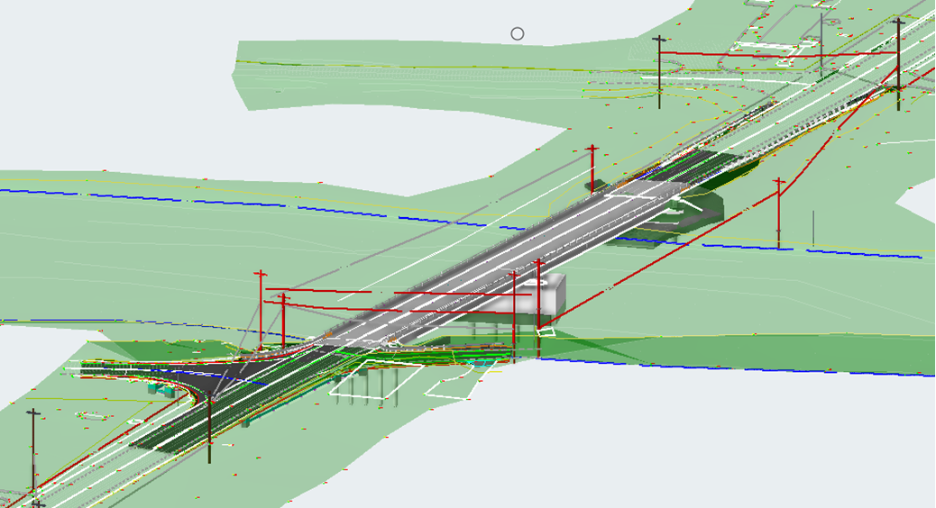
The Pennsylvania Department of Transportation’s (PennDOT) ADCMS bridge initiatives are aimed at transforming how bridge projects are delivered by shifting from traditional paper plans to a fully digital, model-based approach. Central to this effort is the use of open, standardized formats that allow designers, contractors and other stakeholders to work from the same shared 3D model, improving coordination and creating a more accurate record of what is actually built.
A major milestone in this program is the Model as a Legal Document (MALD) pilot, which explores using IFC models as the official, legally-binding deliverables instead of 2D drawings. This represents a significant shift in the industry, requiring teams to test how information is structured, exchanged, and relied upon throughout the project lifecycle. The team is evaluating whether contractors and other partners can confidently use these digital models during construction.
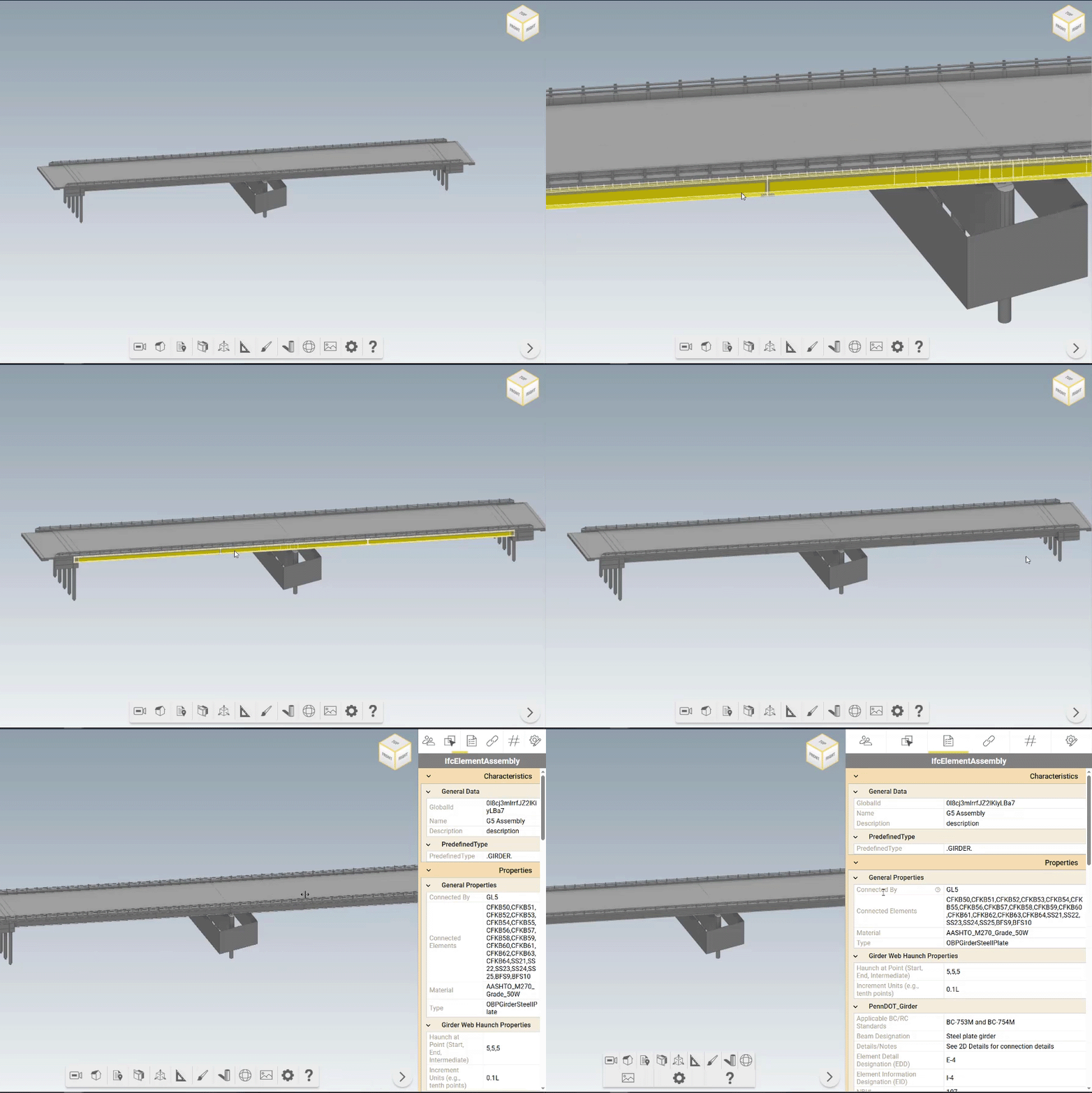
Our team at Michael Baker played a leading role in advancing this approach through the SR 6 pilot project for PennDOT. Leveraging ADCMS funding, the team tested the Information Delivery Manual (IDM) developed by the BIM for Bridges and Structures Transportation Pooled Fund (TPF). This effort marked the first project in the United States to deliver a contractual IFC model that contractors could directly use within their construction tools, demonstrating that a model-based approach can work in practice.
To support broader adoption, the initiative also encourages integrating Industry Foundation Classes Version 4.3 (IFC4x3), an open, vendor-neutral data standard for exchanging BIM and digital infrastructure information between different software platforms, into design and construction software platforms, making it easier to share and use model data across systems. Ongoing collaboration with related research efforts and future project phases helps refine the approach and align it across the industry.
Ultimately, this work is helping establish digital models as the single source of truth for bridge projects. From design through construction and final documentation, these models can serve not only as coordination tools but also as the official record and legal foundation for how infrastructure is delivered.
As more agencies leverage pilot efforts, digital delivery is moving from experimentation to standard practice, helping bridge owners confidently modernize how projects are delivered and managed.
Digital delivery is no longer an emerging concept; it is evolving into practice for how bridges are designed, delivered and managed across their full lifecycle. By aligning digital tools with the needs of people and processes, and combining that with strong industry
The architecture, engineering, and construction (AEC) industry is undergoing a transformation in how infrastructure is planned, designed, constructed, and managed. As agencies move beyond traditional document-centric workflows, digital project delivery is enabling teams to leverage engineered digital models, structured information, and connected data throughout the project lifecycle. More than a technology initiative, this shift represents a new way of delivering infrastructure—one that improves collaboration, reduces risk, supports better decision-making, and creates lasting value beyond construction. Through Building Information Modeling for Infrastructure (BIM4I), agencies are aligning people, processes, and technology to establish a scalable foundation for digital delivery, asset management, and future digital twin capabilities.
Selecting the Right Digital Tools
Digital project delivery and digital twins are two enablers that support the infrastructure lifecycle as part of a BIM4I process or culture. Digital project delivery primarily leverages a Project Information Model (PIM) used during planning, design and construction, where it helps us create and manage a shared digital model that brings geometry, data, and decision-making together. As a bridge, for example, is built and put into service, that same foundation of information can evolve into a digital twin, a dynamic representation that supports inspection, maintenance and long-term operations – or Asset Information Model (AIM). Digital project delivery helps us design and construct infrastructure like bridges more efficiently, while digital twins help owners understand and manage those bridges long after construction is complete. Together, they’re changing how we think about the full lifecycle of data for bridge assets.
With more than 40 colleagues on our team trained in digital project delivery and BIM4I, we’re partnering with clients on BIM4I transformations in over 25 states. Along the way, many of these efforts are extending beyond design and construction to include digital twin components that support long-term asset management. As digital project delivery continues to evolve, we’ve developed our own in-house digital twin environment for development and testing across our practices. This allows us to explore new ideas, validate workflows, and better understand how digital twins can complement digital project delivery as we work toward a BIM4I culture.
Through more than 20 pilot projects and BIM4I program support to over eight State Departments of Transportation (DOTs), we guide agencies in defining clear implementation pathways that translate strategic intent into measurable outcomes by establishing practical work plans built on DOT governance structures and phased deployment strategies that clarify how digital project delivery is implemented, who is responsible, and when key milestones are achieved—drawing from leading practices implemented by agencies such as the California Department of Transportation (Caltrans), Texas Department of Transportation (TxDOT), and Pennsylvania Department of Transportation (PennDOT).
Central to this approach is helping agencies select and apply the right digital tools to manage bridge assets across their full lifecycle—from planning and design through construction and long-term operations—while integrating constructability-driven workflows that account for construction sequencing and staging, erection strategies, site logistics, visualization, and work area constraints. This is especially critical in accelerated delivery methods such as design-build, where real-time collaboration and rapid owner engagement are required, enabling teams to deliver actionable design outputs that support contractor means-and-methods, reduce risk, and improve decision-making and predictability on major bridge programs, with scalable application to agencies such as the Maryland Department of Transportation (MDOT), Ohio Department of Transportation (ODOT), and Nevada Department of Transportation (NDOT).
Incorporating Emerging Technologies
We’re also beginning to see the practical role that emerging technologies like artificial intelligence (AI) can play in bridge design today. For example, in many cases, AI-enabled script files are being used to bridge gaps between existing software tools, helping automate repetitive tasks or connect systems that don’t yet work seamlessly together. These approaches aren’t meant to replace core engineering tools, but rather to serve as thoughtful workarounds while industry software continues to mature. By using AI in targeted, problem-solving approaches, we are maintaining momentum and continuing to advance digital delivery even as the technology landscape evolves.
To stay ahead of where the industry is headed, we are using our in-house digital twin environment for development and testing of these emerging technologies across our practices. This allows us to explore new ideas like integrating bridge condition management, Bridge Weigh-In-Motion (BWIM) and Structural Health Monitoring (SHM) as digital twin use cases. We can also validate workflows and better understand how digital twins can complement digital project delivery in operations and maintenance to streamline inspections and ratings, identifying defects, managing material properties and warranties and further connecting design models for rehabilitations as we work toward a BIM4I culture.
Collaborating Across the Industry
Advancing digital project delivery for infrastructure requires collaboration across the entire transportation industry. Forums like BIM Week bring together Transportation Pooled Fund (TPF) programs, AASHTO committees and the buildingSMART International (bSI) Transportation Summit to align on shared challenges and solutions. A recent key outcome was a joint white paper to AASHTO through the AASHTO Joint Technical Committee on Data Standardization (JSTAN) detailing the importance of AASHTO governance of digital standards. AASHTO has developed a Digital Delivery Task Force to further investigate this need for digital standard governance.
As agencies continue to evolve their BIM4I programs, realizing the full value of digital project delivery requires aligning strategy, standards, governance, and technology across the infrastructure lifecycle. This foundation is critical and we see it put to the test through real-world applications.
In our next blog post, we will explore pioneering pilot projects that are putting digital project delivery into practice.
Learn more about BIM for Infrastructure.
Engineering expertise has always been Michael Baker’s competitive advantage. However, in today’s rapidly evolving landscape, expertise alone is no longer enough. The firms that will define the next decade of infrastructure, technology and government services are those that can put the right knowledge in front of the right professional, at the right moment, on the right project.
Our Technology team at Michael Baker International recently unveiled Titan, a bold new proprietary enterprise AI platform that is doing exactly this. We are redefining how our firm works by putting decades of hard-earned expertise and today’s most advanced AI models directly into the hands of our more than 6,000 engineers, architects and scientists.
By embedding AI into the fabric of our everyday work, rather than treating it as a standalone tool, Michael Baker is evolving into an AI‑native technology engineering firm, one that scales information and expertise in real time to deliver smarter decisions, faster delivery and more resilient outcomes for our clients and the communities we serve.
A Platform for Engineering the Future
Built as a secure, model-agnostic operating layer on Microsoft Azure, Titan allows our teams to instantly tap firmwide knowledge, rapidly make sense of complex data and collaborate across disciplines in real time. What sets Titan apart is its ability to let our employees build and share purpose‑built AI agents, thus turning individual expertise into collective advantage at scale.
Users can engage with Titan with confidence, knowing that all interactions, project data, client information and proprietary methodologies remain within our firm’s managed cloud environment. No data is retained by external AI providers. No client-sensitive content leaves Michael Baker’s secure perimeter, making deep, substantive use of the platform possible.

For example, utilizing Titan, a transportation engineer’s workflow agent becomes available to the entire transportation practice, or a program manager’s proposal analysis tool is accessible to every capture team in the firm, safely and securely. The result is a secure, firmwide ecosystem where expertise travels freely, collaboration accelerates and the full strength of our people is brought to every challenge.
For our clients and the communities we serve, Titan means better outcomes delivered with greater speed, consistency and confidence. By enabling our teams to surface the most relevant expertise, insights and lessons learned at the exact moment they are needed, Titan helps reduce risk, shorten delivery timelines and improve decision-making across complex programs. The result is infrastructure and public service solutions that are more resilient, more responsive and more closely aligned with real-world needs, from safer transportation networks and more sustainable water systems to stronger federal and community facilities. In amplifying the collective expertise of our people, Titan directly enhances the value we deliver to the places and people who rely on our work every day.
Designing Titan from Idea to Impact
Michael Baker has built a deep reservoir of infrastructure expertise across disciplines including transportation, water, environmental, aviation, federal, facilities and more. That knowledge lives in many places: in systems, in documents and most importantly, with the people who deliver our work every day. In an organization with unparalleled levels of expertise, the challenge lays in how to unlock it quickly, connect it across disciplines and apply it at the speed today’s projects demand.
When large language models emerged, our team saw an opportunity to rethink what was possible. Rather than adopting a generic AI tool, we set out to design a secure, enterprise‑wide platform purpose‑built around our people, our collective knowledge and our clients’ needs. That vision became Titan: an AI operating layer that transforms decades of institutional knowledge into real‑time insight.
When we began developing Titan, there was no established playbook for building an enterprise AI platform of this kind within an engineering consulting firm. The development journey required bringing together technology, legal, information security, human resources and operational leadership in ways the firm had not previously coordinated at this depth or pace.
We knew that Michael Baker’s AI transformation was not a side project or a pilot program. It required a fundamental rewiring of how our people access knowledge, how they collaborate across disciplines and how they deliver outcomes.
A Business-Led Roadmap
Titan’s development was driven by a business-led roadmap, not a technology mandate. We identified real workflow friction points across our engineering disciplines:
- Time-consuming proposal research
- Fragmented access to technical precedents
- Manual synthesis of regulatory requirements
- The challenge of capturing and transferring expertise across large, distributed project teams
The platform was piloted with real users across multiple disciplines before broad rollout, with adoption supported by Michael Baker’s AI Champions Network, Communities of Practice and a structured AI learning and development program developed in partnership with leading academic institutions. This bottom-up adoption model, where professionals discover, build and share AI capabilities organically within a governed environment, is what drives the compounding returns Titan is designed to produce.
When early users engaged with a prototype of the platform, they quickly moved beyond basic search and synthesis. They immediately used it for complex technical analysis, proposal development, regulatory research and cross-discipline problem solving. That signal was clear: Titan could become a platform on which we build an entirely new way of working.
Looking Ahead: The Future of Titan
With Titan now available to our entire team, we have reached a milestone, not our destination. The platform’s roadmap includes a CUI-compliant version for our federal and defense clients, deeper integration with our project management and CRM systems, and the continued expansion of the internal agent marketplace as Michael Baker professionals build and contribute discipline-specific tools.
The most anticipated near-term capabilities include Titan’s integration with our digital twin platform, creating a unified AI and spatial intelligence environment for infrastructure asset management and the continued development of Titan’s proposal intelligence capabilities, drawing on our indexed library of thousands of successful project proposals.
While adoption continues to grow, building deep, habitual engagement remains a priority. Platform improvements are only part of our larger roadmap. We will continue to invest in Michael Baker’s AI Champions Network, Communities of Practice and professional development will remain central to making Titan not just available to our workforce, but genuinely transformative for every member of our team who uses it.
We have created something I believe will change how Michael Baker serves our clients, and how we define what a technology-focused, future-forward engineering consulting firm can be.